Chimney Flashing Repair in Brooklyn, Waterbury from $300. An estimated $300 to $1,800 – the commonest source of a leak on an older Waterbury house. Free inspection and a written quote.
Brooklyn's triple-deckers and blocks often carry several flues through one roof, and a failed flashing can put water into a unit some distance away. The roof is surveyed stack by stack rather than from the ceiling that complained.
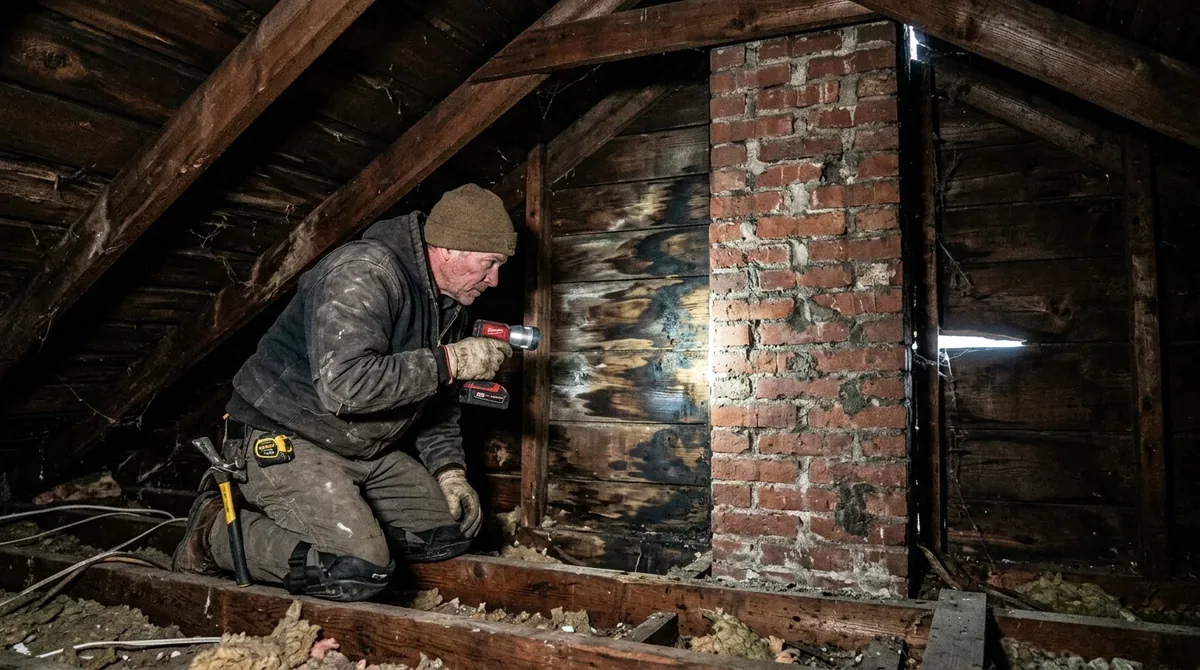
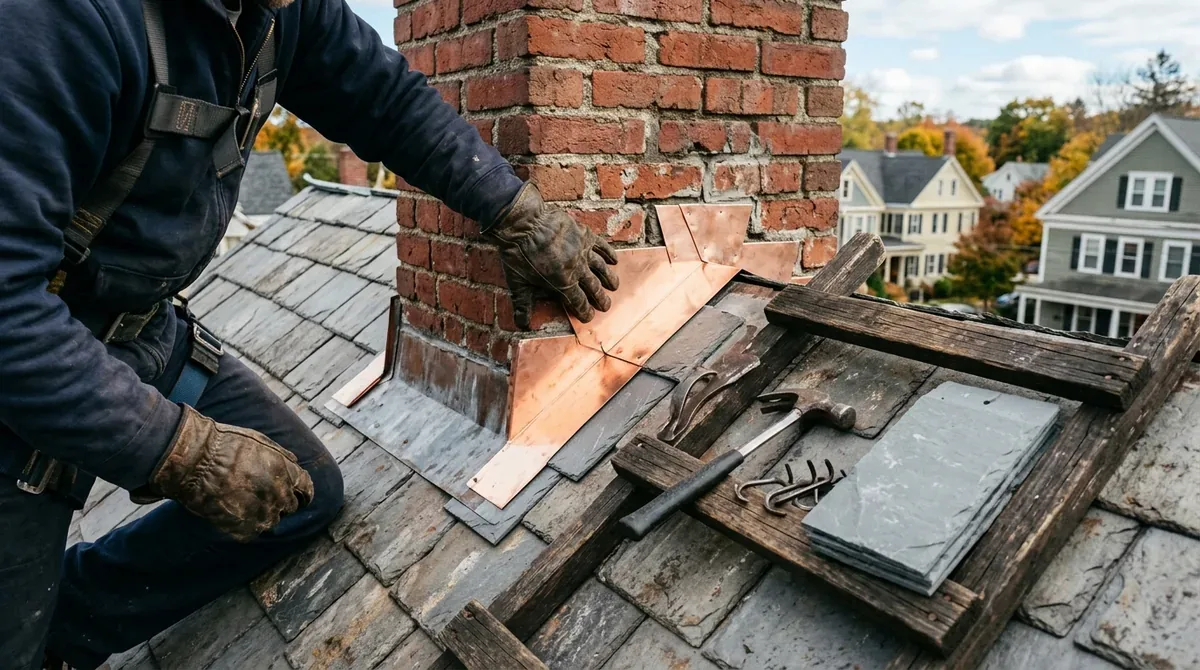
A chimney leaks from one of four places: the step flashing up the sides, the apron at the front, the cricket or back pan behind, or the counter-flashing let into the mortar. On older stacks the mortar is usually the weak link. Once the joints erode the counter-flashing pulls loose, water runs down behind the metal, and caulk on the surface never reaches it.


Chimney flashing repair is estimated at $300 to $1,800 in most cases. It is the commonest single source of a recurring leak on a pitched roof, and Waterbury's pre-war houses have a great many old masonry stacks. Density sets the price: where staging can stand, where a dumpster can go, and whether the building is a triple-decker or a six-family block permitted as a larger building.
One failed detail on sound brickwork – counter-flashing pulled out of a joint, or an apron lifted at a corner.
Eroded mortar that has to be raked and repointed before new metal can bed into it, and a missing cricket on a wide stack.
Fresh caulk on weathered metal. New step flashing is bright against an old stack; reused flashing with a bead run round it looks tidy only from the street.
Six-family blocks are past the size of building the residential code covers, so their roofs are permitted as larger buildings. On close-set triple-deckers the constraint is room to work: staging, a dumpster, and three floors of households.
Here the plan for the street – where the ladder stands and where the tear-off goes – is part of the quote.
All four details, and the mortar behind them.
Step flashing, apron, cricket and counter-flashing are each checked, because the visible one is rarely the only one failing.
Behind any chimney wider than 30 inches a cricket is built, so drifting snow and meltwater go around the stack instead of under the shingles.
Old flashing comes out rather than being caulked over, and new step and counter-flashing is woven into the roof.
In Brooklyn the building decides the paperwork.
In Brooklyn's dense blocks a repair is often at a junction shared with the house next door, or on a roof three floors up over two rented apartments.
A leak in a Brooklyn triple-decker or six-family block reaches more than one household.
Brooklyn has the most genuinely flat roofing on this site: six-family blocks, tenements and storefronts as well as porch roofs.
Slate is rare on Brooklyn's triple-deckers and blocks, but where an older building keeps it, the dense street makes access the hard part: staging that does not land on the neighbor's roof, and no one walking the slate..
In Brooklyn the inspection starts with the building: how many units, and therefore which code and what permit.
One city, one permit office. The 25% line decides it.
Burnt Hill, 1897-1925. Slate and clay tile survive.
Brass-family Queen Annes. Many valleys, steep lots.
Trolley-era half-acre lots. Capes with rooms upstairs.
The 1674 ridge. Farmhouses and well-kept triple-deckers.
Rocky hills, Washington Hill and Hopeville. Access first.
Answered before anyone books a visit.
Because water lands on a rafter and runs along it until something stops it. A stain a room away from the chimney is entirely ordinary, and it is exactly why patching the ceiling side achieves nothing.
If it is wider than 30 inches across the slope, the code asks for one. A cricket sheds water and snow around the back of the stack; without it, drifting snow sits against the brickwork and the meltwater finds its way under the shingles.
Only as a stopgap. Caulk over old metal holds for a season or two, and once the mortar behind the counter-flashing has eroded, water runs behind the metal where no surface sealant reaches.
Every quote states whether the job is a repair or a permitted replacement. The code lines named: ice barrier, deck-joint strip, layer count.