Emergency Roof Repair in Waterbury, CT from $400. Temporary cover tonight, estimated at $400 to $1,500 – and no permanent contract signed under a wet ceiling. Free inspection and a written quote.
Temporary cover is estimated at $400 to $1,500 and quoted on its own. In Waterbury the emergency is as often ice as rain – meltwater behind an ice dam coming through a top-floor ceiling – and the permanent fix is decided in daylight, with three business days to cancel by law.
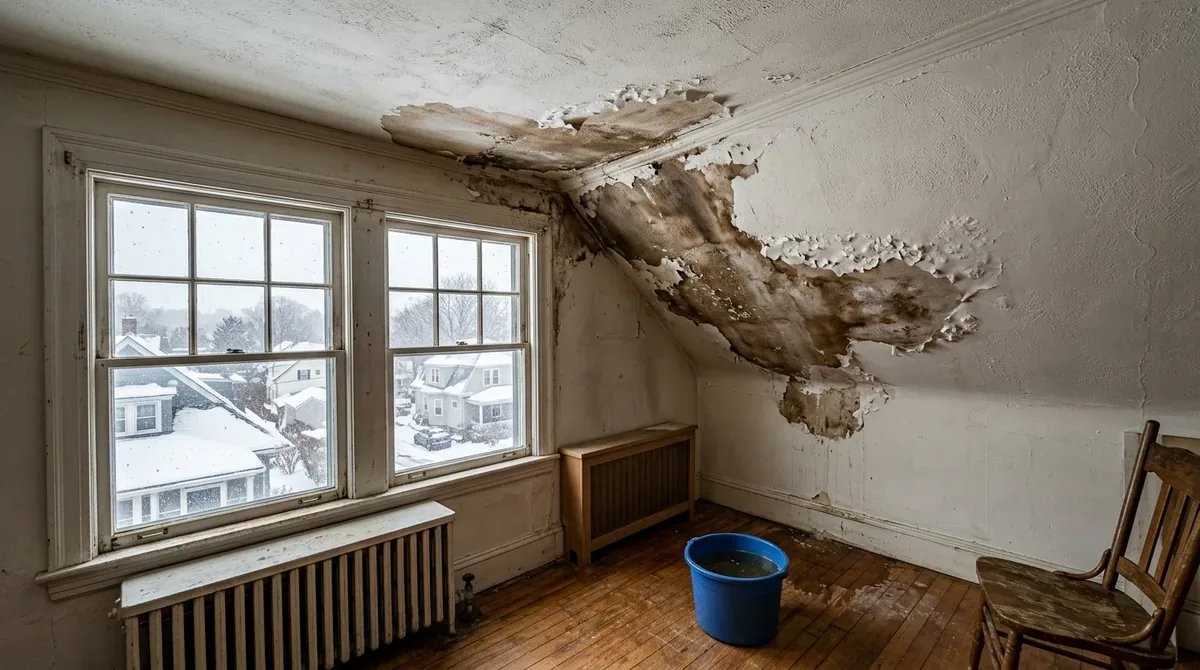
Emergencies here come in two kinds. Wind lifts or tears shingles at a rake, a ridge or a porch-roof edge, and the opening is plain to see. Ice is quieter: a dam forms at a cold eave, meltwater backs up under the courses and comes through a top-floor ceiling with nothing visibly wrong from the street. The first gets covered; the second also needs the dam opened, or the cover only moves the leak.


Temporary cover is estimated at $400 to $1,500 for most homes and is quoted as its own job. It is kept apart from the permanent repair on purpose, so that no five-figure decision gets made while water is still coming in. One Department of Inspections for the whole city, so the permit cost is the same formula everywhere – $50 plus $25 per $1,000 of work. What moves the number between neighborhoods is height, slope and how many families the roof covers.
Calling while it is light and while the opening is still small. A slope left open through two storms is a bigger job than the same slope after one.
Height, pitch and weather at the time: a third-floor roof in wind, ice on the slope, or a flat roof with no eave to lap a cover over.
Ask anyone to sign for a permanent repair at the callout. Connecticut gives three business days to cancel a home improvement contract, Saturday included.
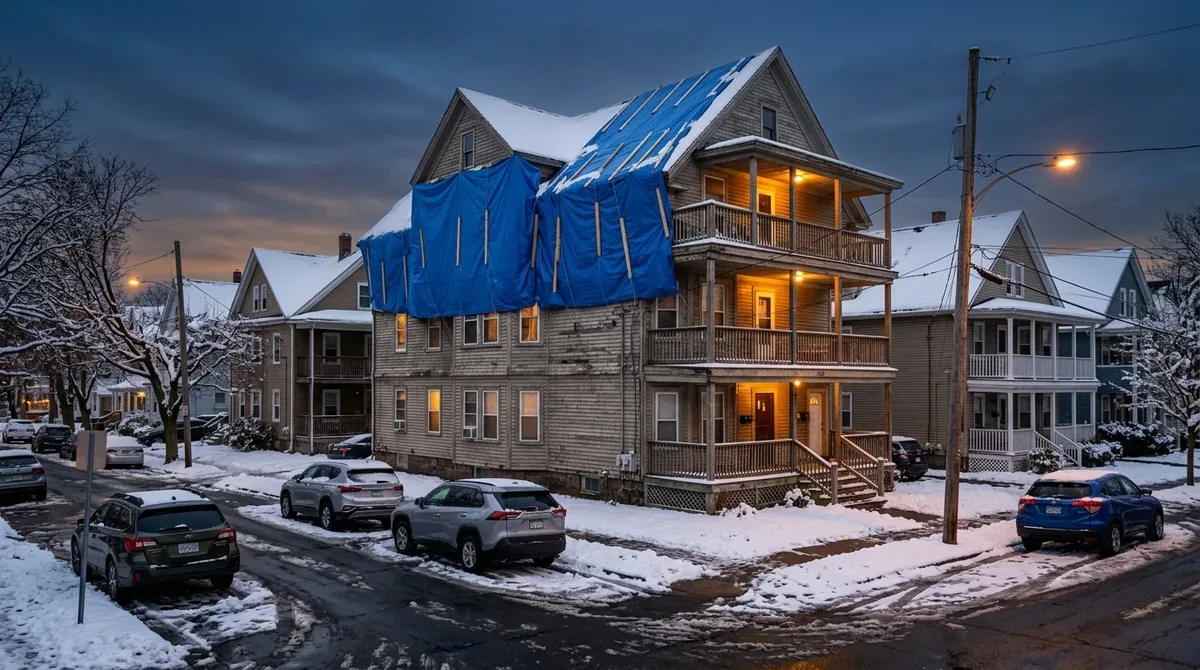
One city and one Department of Inspections, so the permit rules do not change between neighborhoods – the buildings do. A two-family house can use the 25 percent repair line; a three-family house sits outside the residential code, which is worth confirming before anything is called a repair.
The first question on any Waterbury roof is how many families live under it, because the answer decides which code is talking.
Connecticut's Home Improvement Act gives a homeowner until midnight of the third business day to cancel a home improvement contract, and Saturday counts as a business day. The only exception is a genuine emergency the homeowner describes in their own handwriting – which is exactly why nobody should be handed a permanent contract at midnight.
Water stopped first, decisions later.
A tarp battened over the opening and lapped well past it so wind cannot get under; on an ice-dam leak, a channel opened through the dam so the meltwater can drain.
Before anything is covered, the failure is photographed, so the permanent repair is quoted from evidence rather than memory.
The permanent repair is written up afterwards as its own quote, with your three business days to cancel, Saturday included.
In Waterbury every full re-roof is a permitted job, because Connecticut's code excuses only repairs under a quarter of the roof.
Most repairs are estimated at $400 to $2,000, and Connecticut caps what a repair can be: 25 percent of the roof covering in a calendar year, after which it needs a permit.
Low-slope roofing is estimated at $4 to $10 a square foot, and in Waterbury it is porch roofs, rear additions, garages, storefronts and the bigger multi-family blocks.
Slate repair is estimated at $500 to $3,000 for most jobs, and the code allows no covering over slate, so repair is the only alternative to a full strip.
Chimney flashing repair is estimated at $300 to $1,800, and with three homes in ten built before 1940 Waterbury has a great many old stacks.
An inspection is free with a quote, and every report states where the work falls against Connecticut's 25 percent line – a repair with no permit, or a replacement with one – before anyone puts a price on it..
Burnt Hill, 1897-1925. Slate and clay tile survive.
Brass-family Queen Annes. Many valleys, steep lots.
Trolley-era half-acre lots. Capes with rooms upstairs.
The 1674 ridge. Farmhouses and well-kept triple-deckers.
River to ridge. Triple-deckers and six-family blocks.
Rocky hills, Washington Hill and Hopeville. Access first.
Answered before anyone books a visit.
For an active leak, where light and weather allow the roof to be worked safely. Temporary cover is quoted as its own job and commits you to nothing further. A steep or third-floor roof in wind or ice after dark sometimes cannot be walked safely, and we will say so rather than take the call.
No, and nobody should ask you to. Connecticut gives you until midnight of the third business day to cancel a home improvement contract, Saturday included, so nothing is gained by deciding while water is still coming through the ceiling.
Move belongings away from the leak and put a bucket down. Keep clear of any wet ceiling near a light fitting, and switch that circuit off if you can do so safely. Photograph the damage before anything is moved.
Every quote states whether the job is a repair or a permitted replacement. The code lines named: ice barrier, deck-joint strip, layer count.