Roof Replacement in Hillside, Waterbury, typically $10,000 - $18,000 (est.). Brass-family Queen Annes. Many valleys, steep lots. Local crew, a free written quote, and the permit pulled through the Waterbury Department of Inspections.
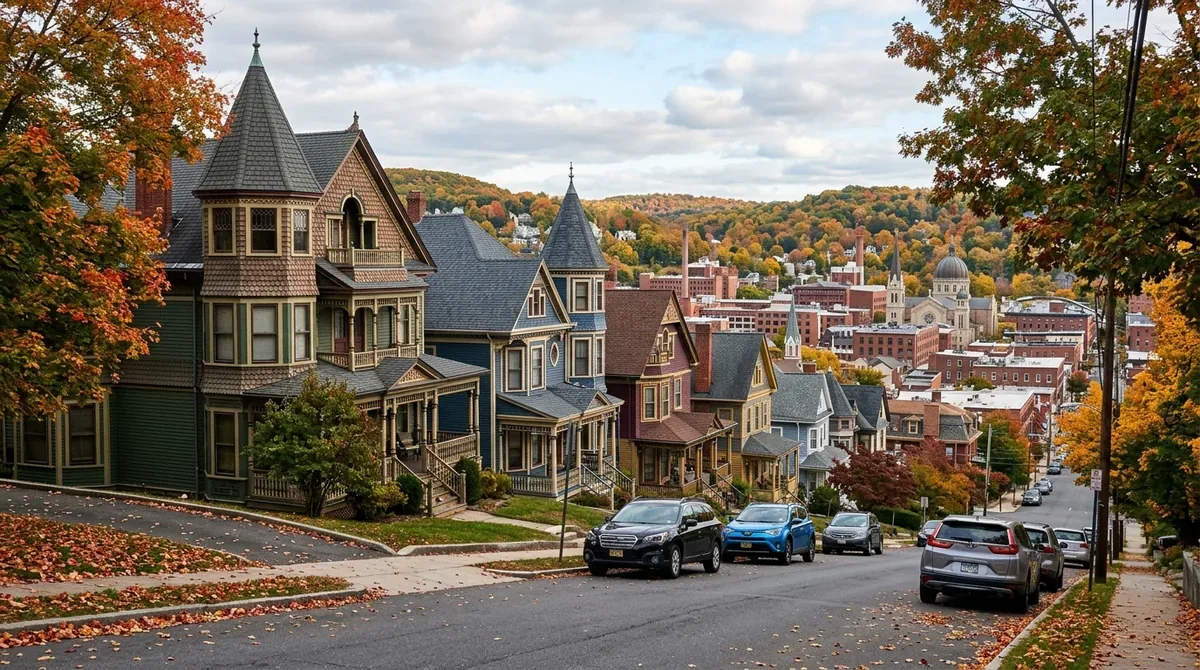
The most complicated roofs in the city: many planes, many valleys, steep dormers, on lots that fall away sharply. Staging on the slope is as much of the price as the covering.
On a roof with this many valleys, the valley detail is where the budget should go first.
The steep slope above downtown, where the brass families – Scovill, Chase, Benedict and others – built between the 1840s and 1920. Mostly Queen Anne, including Palliser designs remembered for their picturesque rooflines, with a Gothic cottage, Flemish gables, Tudor half-timbering and later apartment buildings among them.

7 lanes of roofing work, each priced against a written scope.
A Queen Anne on the Hillside is the most expensive roof shape in the city to replace: many planes, many valleys, steep dormers, and a lot that falls away under the staging.
On a Hillside Queen Anne the recurring repair is almost always a valley or a dormer cheek.
On the Hillside's steep lots a night callout is limited by where a ladder can safely stand.
On the Hillside, flat roofs sit on porches, bays and the later apartment buildings among the Queen Annes.
Where a Hillside house still carries slate, its steep, broken roof lines make every repair an access problem first.
The Hillside's big houses often have several tall chimneys rising through steep, complicated roofs.
On a Hillside Queen Anne the inspection counts valleys, dormers and junctions as carefully as it measures area, because that is where these roofs fail and where their price comes from.
Worth knowing before you start calling round, because the busiest weeks are the worst weeks to be choosing.
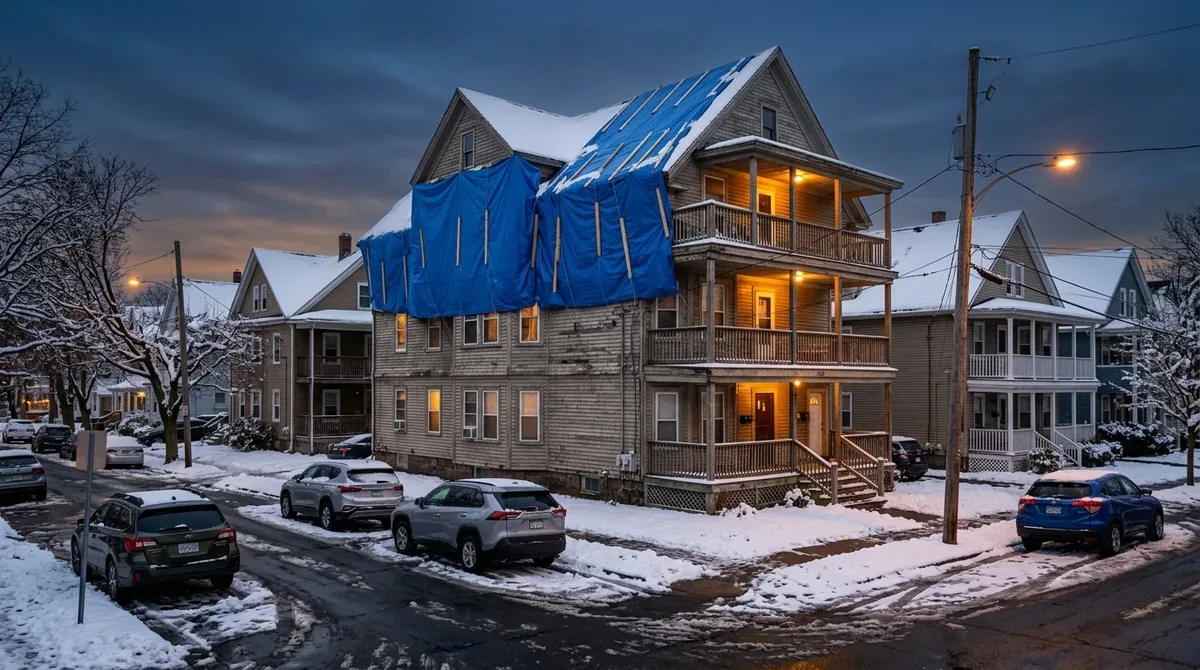
Waterbury's snow season runs from about November into April, and January is usually the heaviest month. Roofs here fail at the eaves: meltwater backs up behind an ice dam, gets under the shingles and comes through a top-floor ceiling during the first real thaw – so the calls arrive together, across the whole city, in the same few days.
Shingles also need warmth to seal down properly, which is one more reason a replacement arranged in late summer or early fall is a better roof than the same job rushed in February. The permit takes the same time either way; the weather does not.
One city, one permit office. The 25% line decides it.
Burnt Hill, 1897-1925. Slate and clay tile survive.
Trolley-era half-acre lots. Capes with rooms upstairs.
The 1674 ridge. Farmhouses and well-kept triple-deckers.
River to ridge. Triple-deckers and six-family blocks.
Rocky hills, Washington Hill and Hopeville. Access first.
Published ranges and straight answers, before you ring round.
As an estimate, roughly $10,000 to $18,000 in architectural asphalt, but the floor area is the wrong number to price from. A two-story house of 2,200 square feet has a much smaller roof than a single-story one of the same size, and pitch, valleys and the number of layers coming off move it further. A written quote should measure the roof itself and show the rate per square foot.
Not on age alone. Twenty years is when an asphalt roof deserves an inspection, not an automatic replacement. If the shingles are holding their granules, the flashings are sound and the attic shows no water tracks, it may have several winters left. Curling, bare patches, repeated leaks at the eaves or two layers already in place are the signs that it is time, and an honest inspection says which you have.
One to three days on site for most asphalt roofs on a house that size, once the permit is issued and the weather allows. Steep pitches, a second layer to strip, a lot of rotten decking or a three-story building with staging push it longer. Plan around the snow: a roof booked for early fall is far easier to schedule than one needed in January.
In Connecticut it is a permit line. The state's amended residential code excuses from a building permit only repairs limited to 25 percent of the roof covering within one calendar year. Under that line, on a one- or two-family house, a repair needs no permit; over it, the job is a replacement and is permitted through Waterbury's Department of Inspections. The 25 percent rule most websites describe is Florida's, which works differently. A three-family house sits outside the residential code, so check with the department before relying on the exemption there.
Registration number and dates on the contract, as CT law requires. Connecticut figures, estimated as ranges, not a national calculator.