Roof Replacement in Bunker Hill, Waterbury, typically $10,000 - $18,000 (est.). Trolley-era half-acre lots. Capes with rooms upstairs. Local crew, a free written quote, and the permit pulled through the Waterbury Department of Inspections.
Capes with rooms in the roof are the thing to establish first. A finished upper story changes the ventilation and makes the eaves harder to detail, and the eaves is exactly where Connecticut's ice barrier rule does its work.
On a cape, find out whether anyone sleeps up there before anything else gets decided.
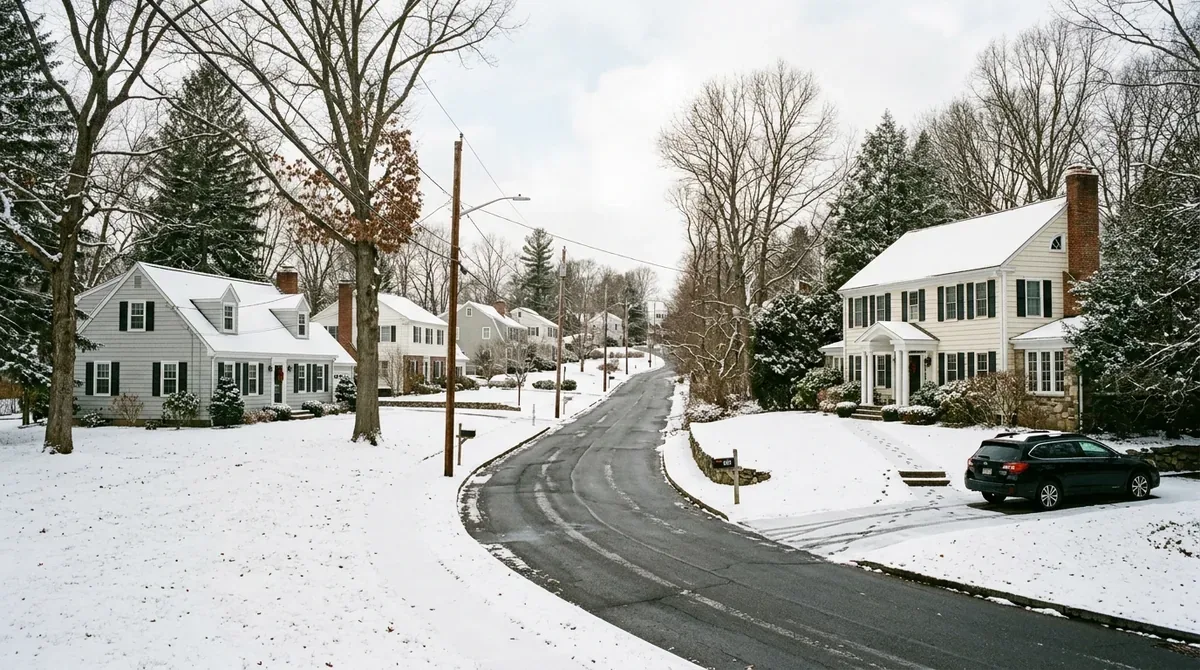
Farmland until the trolley came; subdivided between about 1890 and 1920, when one builder alone put up more than ninety houses on half-acre lots. Tornadoes crossed it in 1962 and 1989. Lower-density middle-class housing – colonials, capes, and later ranches and split-levels – on bigger lots than most of the city.

7 lanes of roofing work, each priced against a written scope.
The most straightforward replacements in Waterbury are on Bunker Hill: bigger lots, room for a dumpster in the drive, and plainer roofs on colonials and later ranches.
On Bunker Hill capes the classic repair is at the eaves of a finished upper story, where warm rooms melt snow that refreezes at the cold overhang.
Bunker Hill's emergencies are mostly ice dams on capes and storm damage on bigger, open lots where trees and wind reach the roof.
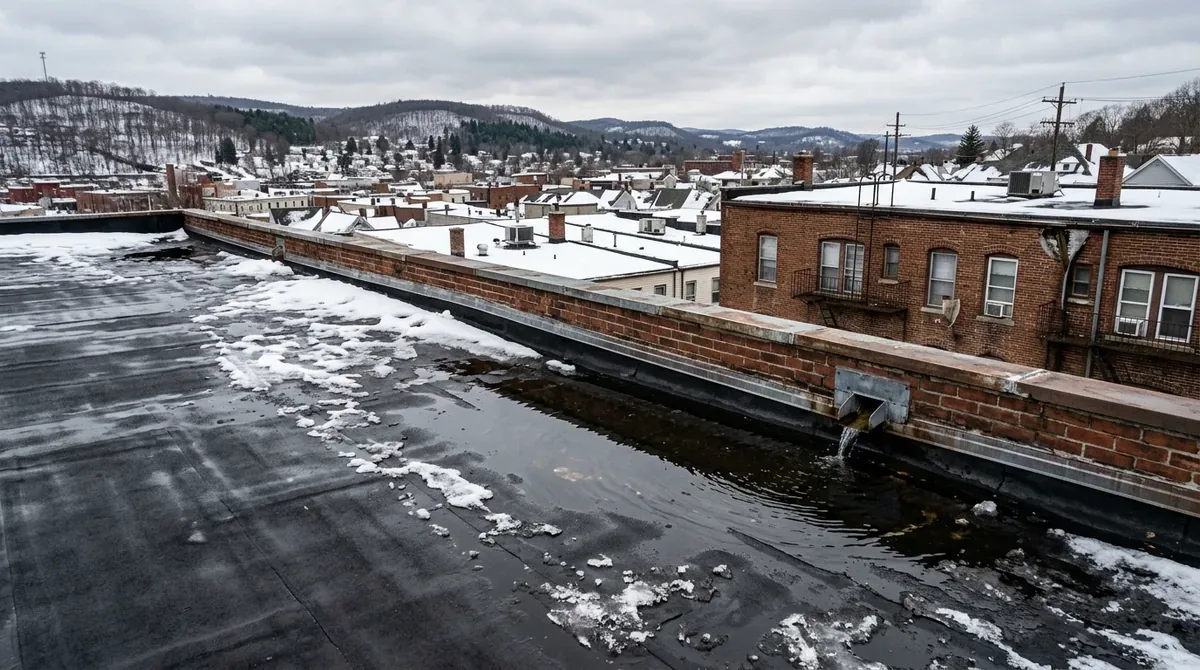
On Bunker Hill the typical flat roof is a garage, a breezeway or a rear addition on a cape or ranch, draining onto a pitched roof or a driveway.
Slate is uncommon on Bunker Hill's colonials, capes and ranches, so a slate repair here is usually on one of the older houses from the trolley-era subdivisions.
On Bunker Hill capes the chimney often rises through a finished upper story, so a flashing leak shows as damp on a bedroom wall rather than in an attic.
On Bunker Hill the inspection establishes whether the roof space is finished rooms or open attic.
Worth knowing before you start calling round, because the busiest weeks are the worst weeks to be choosing.
Waterbury's snow season runs from about November into April, and January is usually the heaviest month. Roofs here fail at the eaves: meltwater backs up behind an ice dam, gets under the shingles and comes through a top-floor ceiling during the first real thaw – so the calls arrive together, across the whole city, in the same few days.
Shingles also need warmth to seal down properly, which is one more reason a replacement arranged in late summer or early fall is a better roof than the same job rushed in February. The permit takes the same time either way; the weather does not.
One city, one permit office. The 25% line decides it.
Burnt Hill, 1897-1925. Slate and clay tile survive.
Brass-family Queen Annes. Many valleys, steep lots.
The 1674 ridge. Farmhouses and well-kept triple-deckers.
River to ridge. Triple-deckers and six-family blocks.
Rocky hills, Washington Hill and Hopeville. Access first.
Published ranges and straight answers, before you ring round.
For an asphalt roof on an ordinary Waterbury house, yes: it is well above the estimated $10,000 to $18,000 most houses cost, and about a tenth of the city's typical home value. It is not unreasonable for slate work, a large Queen Anne on the Hillside with many valleys, or a big multi-family building. The figure alone does not settle it; the itemized roof area, tear-off, decking rate and permit do.
Waterbury charges $50 for the first $1,000 of estimated cost and $25 for each additional $1,000, plus a state fee of $0.26 per $1,000. On a $14,000 roof that is about $380; on a $20,000 roof about $530. Permits come from the Department of Inspections at 185 South Main Street, and the contractor normally pulls the permit as part of the job.
In Connecticut it is a permit line. The state's amended residential code excuses from a building permit only repairs limited to 25 percent of the roof covering within one calendar year. Under that line, on a one- or two-family house, a repair needs no permit; over it, the job is a replacement and is permitted through Waterbury's Department of Inspections. The 25 percent rule most websites describe is Florida's, which works differently. A three-family house sits outside the residential code, so check with the department before relying on the exemption there.
An asphalt roof replacement in Connecticut is estimated at $10,000 to $18,000 for most houses, with architectural shingle at about $4.50 to $8.00 per square foot installed. Slate is a different order of money, estimated at $15 to $30 or more per square foot. In Waterbury add the permit, roughly $380 on a $14,000 job, and allow for decking as a rate per sheet, because nobody knows how much is soft until the old roof is off.
Registration number and dates on the contract, as CT law requires. Connecticut figures, estimated as ranges, not a national calculator.